Companion site
The Scribe’s Advantage
How Civilizations Hoard What They Know and What Happens When They Choose to Burn It
Will Adler
The book is finished. News will be posted here.
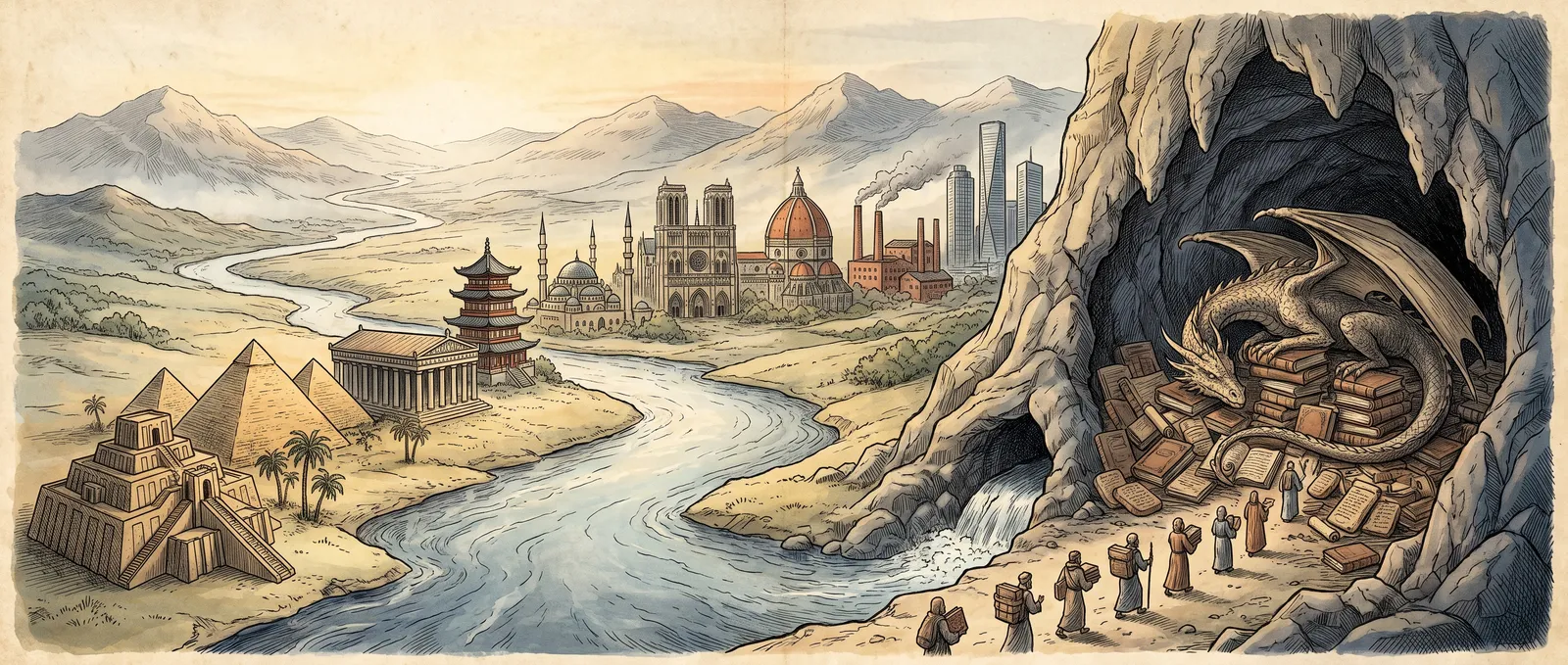
The Cave Map: 5,000 years of cities, each in the ink of the dragon holding its gate. Open the full map, with the river and notes →
Every civilization that compounds knowledge eventually builds a class to guard it. Scribes, lawyers, professors, coders. That class starts by serving the society that feeds it. Then it starts serving itself. The book calls this capture: when the people who hold the knowledge stop producing new knowledge and start protecting old credentials.
This site scores that pattern across 5,000 years of history, seven modern professions, and a framework you can test yourself. No book required. If the numbers interest you, the book tells the stories behind them.
54
Civilizations and periods on the scorecard
7
Professions tracked
5,000+
Years of data
Explore the data
Each tool stands on its own. Start anywhere.
Illustrated and animated
The Field Guide
The book’s whole vocabulary, drawn: a dragon growing through its four ages, the claw clenching on the gate, the body settling into a dam, the four piles filling, and the ouroboros closing its ring. Plus all twenty-two plates and an A to Z glossary.
Open the guide →Interactive
Score Your Own
Four sliders, three checkboxes. Name any civilization or profession, score it on four axes, and see whether the pattern matches capture or compounding.
Try it →54 civilizations and periods
Civilization Scorecard
Every civilization and period on the scorecard, row by row, with the 17 capture cases and 29 four-axis stability profiles behind them. Sort by any axis, filter by fate, click a row for the evidence behind each score.
Explore →7 professions
Scribal Saturation
How much does each profession write, and how much of it is new? The silt to salt ratio, career by career: the author’s best-guess era when each one tipped from discovery into paperwork, with the evidence for and against.
Explore →13 snapshots
The Stolen River
Population is the theoretical volume. Literacy is the discharge. Slavery pumps the water away; gender and caste gate it at birth; clenched is the gate become a dam, letting through only a controlled trickle. Plus Pyramid Lake, and the dimensions of the Ming flood.
Explore →8 civilizations
Women’s Compounding Score
Who was allowed to compound? Eight civilizations scored backward from today, and the five-thousand-year mortality tax that held women out of the scribal class.
Explore →59 civilizations
The Dragon’s Hoard
Total knowledge accumulated per civilization, scored over time. River to cave to dragon to hoard, and what compounds when the dragon’s gems move to an open cave.
Explore →31 cases scored
Dragon Scoring
What the dragon burned, what the enslaved scribe carried, and which traditions smashed the spine. Three instruments across five thousand years, ranked by the Dragon’s Malice Score.
Explore →11 civilizations
Wise Dragons
Watch eleven civilizations grow up, clench, bite, and learn. Four stages on one timeline, with the compound treasure rate each hoard earned at every crossing and regression.
Explore →Data
The Data Behind the Book
Every dataset the book rests on or takes a number from, with its sources, as CSV and JSON.
Download →Methodology
How the Scoring Works
The four axes, the three-condition capture matrix, the six fates, and the metaphor system that ties them together. The methodology appendix.
Read more →